This hands-on course bridges the gap between basic PLC sequencing and full-scale factory floor automation using the TW Controls 2-Axis Pneumatic Pick-and-Place Training Station. Designed for maintenance technicians, plant engineers, and automation professionals, the curriculum focuses on integrating industrial fluid power with automated control systems.
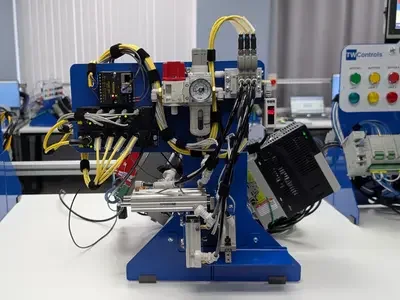
Participants will explore real-world component functionality, beginning at the air preparation system—including lockable safety shut-off valves for lockout-tagout (LOTO) protocols and filter regulators. The training guides you through the mechanical, electrical, and programming aspects of a dual-axis pick-and-place application. You will handle single-acting and double-acting solenoids configured on a manifold, program guided cylinders with extend/retract limit switches, and manage part detection using a pressure switch on the end-of-arm gripper.
Beyond core motion sequencing, this course emphasizes modern plant efficiency and machine optimization. Utilizing an onboard flow meter and real-time data, you will monitor air consumption, identify energy-wasting air leaks, and calculate the concrete kilowatt-hour utility costs associated with pneumatic system inefficiencies. By completing this course, you will possess the practical skills to safely wire, program, troubleshoot, and optimize high-performance pneumatic automation systems.
Industrial Pneumatics & Pick-and-Place Integration Course
100% Free • Open Access • No Account or Login Required
Who are we? Tim Wilborne has over 1000 videos, 12 million views, and over 100K subscribers on Youtube. He has been in the industry over 30 years, starting off in a machine shop when he was 12 and building his skills up as a maintenance technician and UL 508A Industrial Control Panel Builder. He has a thing or two to teach you.
Who will benefit? Anyone looking for the fast track to learning PLCs. Whether you have experience with another brand of PLC and you are completely new, these self guided lessons will give you the tools you need to succeed. We have had people from many careers in our course including engineers, technicians, software engineers, college students, and even high school students.